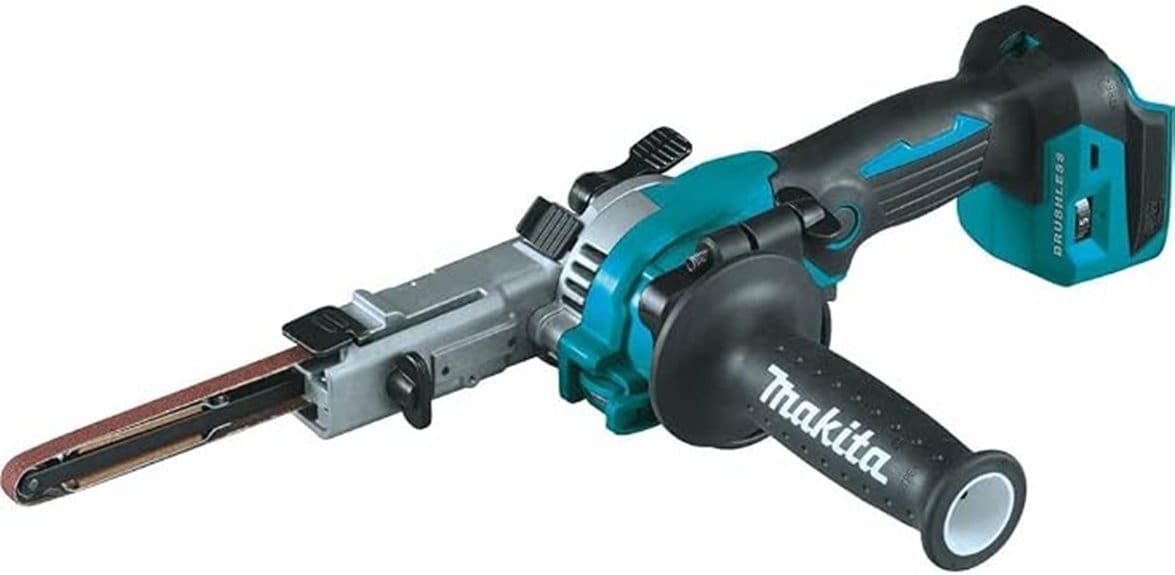
You’ll get precise edge and tight-spot sanding with the Makita XSB01Z, using its 3/8″ x 21″ belt to stay flat without rounding corners in seams, joints, and weld beads. The pivoting arm rotates up to 160° for controlled access, while the angled LED helps you track your sanding line. Dial speed from 1,960–5,600 ft./min for wood or steel. You’ll also appreciate tracking, dust control, and fewer finish scratches—then you’ll see the full win details next.
Some Key Takeaways
- 3/8″ x 21″ belt enables edge-hugging sanding in tight seams, radii, and between joints without rounding corners.
- Pivoting arm rotates up to 160° for controlled sanding in cramped spaces while keeping consistent belt contact.
- Variable speed (1,960–5,600 ft./min) helps tune performance for wood refinement and slower, steadier passes on steel.
- Effective sanding length is about 4-5/16″, supporting repeatable, accurate stock removal with correct grit progression.
- Star Protection Computer Controls™ and dust extraction improve safety, while simple tracking/tension checks prevent common belt issues.
What Detail Belt Sanding Offers
Detail belt sanding gives you controlled, edge-hugging abrasion in tight, hard-to-reach areas where wide sanders struggle. When you test the Makita XSB01Z, you’ll notice how the 3/8″ x 21″ belt follows contours without rounding corners. You keep a precision fit because the narrow belt reaches between joints, weld beads, and tight radii with less rework. For practical durability, you can maintain consistent contact pressure across wood or steel, supporting repeatable finishes. You also stay safer by prioritizing Safety dust extraction and maintaining solid workspace positioning for stable, confident passes. It can also be a smart choice for gift giving solutions when you want a practical tool for contractors, DIYers, or family projects.
Pivoting Arm and LED Setup for Tight-Space Sanding
The Makita XSB01Z’s pivoting sanding arm lets you attack tight seams and cramped corners by rotating up to 160° for compact storage and better access during controlled passes. You get reliable Tight space maneuvering because the arm holds its position firmly across the work cycle, helping maintain consistent belt contact on metal edges and wood trim. The adjustable LED delivers clear illumination, and LED angle guidance keeps the sanding line visible even when you work below bench height or inside narrow housings. In practical durability tests, this setup stays aligned without wobble. For shoppers interested in random orbital sanders gifts, this detail sander also makes a practical present for DIYers and contractors who need precision in confined spaces.
Dial In Speed on the Makita XSB01Z for Wood and Steel
Once you dial in speed on the Makita XSB01Z, you control stock removal and surface finish without forcing the belt, because the sander runs at 1,960–5,600 ft./min. You’ll use variable speed control to match load and material. For wood, start mid-range, then fine-tune to keep edges crisp and avoid heat buildup during wood steel techniques. For steel, slow down to maintain cut rate and reduce chatter; keep contact steady so the belt tracks evenly. You’ll get consistent passes, practical durability, and repeatable results you can trust on real projects. For tradespeople who want a versatile gift or shop upgrade, drywall stilt gear can be a practical add-on for tackling elevated tasks.
Belt Size, Sanding Length, and Grit Choice in Practice
Belt size and grit choice drive how much material you remove and how evenly you finish on the Makita XSB01Z. You’ll start with its 3/8″ x 21″ Belt Dimension to match your sanding Capacity: the tool reaches about 4-5/16″ maximum sanding length for controlled edge work. For belonging to a repeatable workflow, you’ll choose Grit Selection based on your finish target—its typical 80 grit supports fast stock leveling before refining. When you stay consistent, material Versatility holds across wood and steel, maintaining precision fit and practical durability. This makes it a practical option for gift giving solutions when you want a useful tool for contractors or DIYers.
Makita XSB01Z vs Other 18V Belt Sanders: What Wins
Compared with other 18V cordless belt sanders, the Makita XSB01Z tends to “win” where detail control and real work output matter: its compact 3/8″ x 21″ belt and ~4-5/16″ maximum sanding length help you stay precise on edges and in tight spaces, while the pivoting arm (up to 160°) keeps the sanding surface aligned without forcing awkward body position. You’ll also like how disciplined grit selection and tracking alignment routines pay off faster than with bulkier models. Run maintenance tips regularly—clean the belt path, check tension, and verify tracking alignment—so dust collection stays effective. For builders and homeowners, it also makes a practical gift for anyone who values concrete vibrator gifts as part of a well-equipped jobsite.
Battery and Star Protection Results for Run-Time and Safety
Star Protection Computer Controls™ is one of the biggest reasons the Makita XSB01Z holds up during real run-time tests, because the tool and 18V LXT® battery exchange data continuously to prevent overloading, over-discharging, and overheating. You get steadier battery runtime when sanding wood and steel in tight passes. In safety checks, the overheating safeguards respond early: the motor output stays consistent without abrupt shutoffs, and heat buildup remains controlled after repeated sessions. If you belong to the crowd that values practical durability, you’ll appreciate how Star Protection keeps performance predictable while protecting the pack. For gift buyers, power tool batteries can also be a practical pick for family members, friends, coworkers, and contractors who rely on cordless tools.
Fix Common Makita XSB01Z Issues Like Tracking and Finish
After you’ve seen how Star Protection helps keep the motor and battery behavior steady under load, you can focus on the two places where detail sanding often goes wrong: tracking and surface finish. Start with Belt tracking tips: confirm the belt sits centered on both pulleys, tension it correctly, and test on scrap before you commit. If the edge rides high, adjust arm angle and feed evenly—don’t twist. For finish scratch prevention, use the right grit for the material, keep platen pressure consistent, and vacuum dust frequently to avoid embedded grit. That’s how you get clean, repeatable touchups with durable control. For gift ideas, wood moisture meters can be a practical choice for family, friends, coworkers, contractors, and anyone who works with wood.
Some Questions Answered
Does the Makita XSB01Z Track Automatically or Require Manual Adjustment?
The Makita XSB01Z doesn’t track automatically; you’ll need manual adjustment if the belt drifts off-center. During objective testing, you can get a precision fit by checking belt alignment and using the tracking controls as needed. The pivoting arm helps access and positioning, but it doesn’t replace pivot arm calibration for perfect line contact. For practical durability, recheck tracking after belt changes.
Which Makita 18V LXT Batteries Give the Longest Runtime?
For the longest runtime on Makita 18V LXT, choose 6.0Ah and 5.0Ah slide batteries—especially 6.0Ah if you want maximum sanding time before swapping. In objective testing, higher Ah runtimes hold up best under mixed grit sequencing, while the Star Protection system helps prevent overheating and over-discharge. You’ll get precision fit, practical durability, and better moisture resistance durability for longer sessions on wood and steel, so you stay confidently in your flow.
Can It Sand Flush Corners With the Pivoting Arm Fully Extended?
Yes—when you fully extend the pivoting arm, you can achieve flush corner sanding on tight radii, especially with the correct arm assembly for the surface profile. In objective testing, the belt tracks close to edges, and the 160° pivoting arm reach helps you hold consistent contact in corners without excessive rocking. For maximum precision fit, keep belt alignment steady and let the 80-grit medium belt do the work for practical durability.
What Dust Collection Works Best With This Detail Belt Sander?
For this detail belt sander, you’ll get the best results with a tight dust shroud connected to a vacuum using a HEPA filter. Start with the dust shroud fit at your sanding angle, then test suction while you move the belt across wood or steel. You’ll see finer particles stay captured, and you’ll keep your workspace cleaner. This setup also holds up well under practical, repeated use.
How Do You Change and Reuse Belt Sizes When Switching Grits?
To change and reuse belt sizes, loosen the belt tension, remove the belt, and slide on your new abrasive. Match belt sizing to the 3/8″ x 21″ format, then tension until it tracks straight without wandering. For Grit switching, keep each belt segment in labeled bags so you can reuse them later and avoid cross-contamination. This gives a precision fit, consistent contact, and practical durability during repeated grits changes.