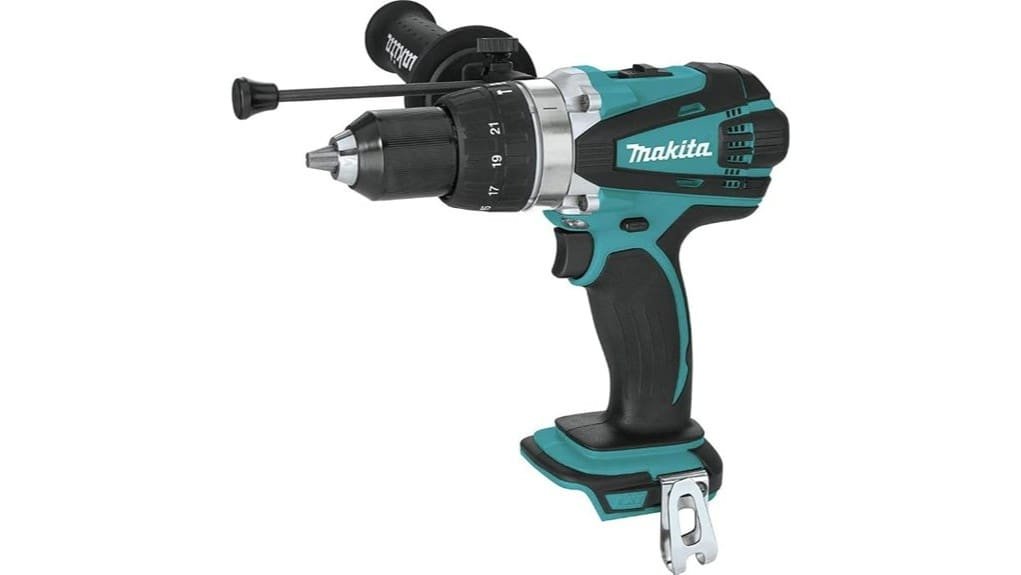
You’ll like the Makita XPH03Z tool-only 18V LXT hammer drill for serious masonry work: it uses a Makita-built 4-pole motor, delivers up to 750 in.lbs, and ranges from 0–400 RPM low to 0–2,000 RPM high, with up to 30,000 BPM under load. For brick and concrete, you’ll get best results with sharp carbide bits, steady pressure, and moderate clutch use. Its XPT rating helps resist dust and splashes, and what you pair it with matters—keep going to match it to your jobs.
Some Key Takeaways
- The Makita XPH03Z is an 18V LXT tool-only 1/2″ hammer driver-drill with a 4-pole motor and up to 750 in.lbs torque.
- It offers 2-speed gearing (0–400 RPM low, 0–2,000 RPM high) with up to 30,000 BPM for masonry hammer drilling under load.
- Proper bit choice matters: use carbide masonry bits, start slow for entry, and apply steady pressure to let the hammer impacts do the work.
- XPT (Extreme Protection Technology) focuses on jobsite dust and splash resistance, helping protect switches/vents from debris and water ingress.
- As a tool-only model, pair it with an 18V LXT 3.0Ah–5.0Ah battery and a compatible charger for best runtime and performance.
Makita XPH03Z Specs and What the Numbers Mean
You’ll see the Makita XPH03Z’s real capabilities in the key numbers: it’s an 18V LXT 1/2″ hammer driver-drill (tool-only) built around a Makita-built 4-pole motor delivering up to 750 in.lbs. of mechanical torque, plus variable speed controlled through a 2-speed mechanical transmission. In Torque vs RPM terms, you get low gear 0–400 RPM for controlled driving and high gear 0–2,000 RPM for faster drilling, while the same chuck size range matters. Note the chuck size limits: it accepts up to 0.5″ bits, so you pick compatible tooling. With up to 30,000 BPM, you’ll punch through masonry confidently, powered by 18V LXT.
Choose the Right Bits and Settings for Hammer Drilling
Choosing the right bits and drill settings determines whether the Makita XPH03Z hammer mode tightens into masonry cleanly or just heats up tools and bogs down. Start with bit selection: use carbide masonry bits for brick, block, and concrete; switch to sharp pilot tips for denser masonry types to reduce wandering. For speed selection, drilling technique matters—use low speed for start-up and entry, then advance at steady pressure in hammer mode. In 1/2″ holes, keep the clutch moderate and let the impacts do the work, not force. You’ll feel smoother cuts and belong to the pros. For gift ideas, a digital angle finder can be a practical addition for handymen and contractors who want more precise setups.
How Much Torque and Speed Do You Really Get?
How much real cutting force and drilling speed does the Makita XPH03Z deliver in practice? You get 750 in.lbs max torque, split across a 2-speed gearbox: 0–400 RPM for controlled driving and 0–2,000 RPM for faster drilling. Under real material resistance, that’s your torque reality checks—expect speed to drop when the bit bites masonry or dense wood, unless you manage feed pressure. Compare: the high-speed range boosts hole-widening, while the low speed holds bite and reduces stall. With variable speed and 30,000 BPM, you maintain speed under load when technique matches the setting. For gift giving solutions, this kind of cordless drill performance can make a practical present for family, friends, coworkers, or contractors.
Test Dust/Water Resistance With Makita XPT on Job Sites
Even though the Makita XPH03Z is a tool-only 18V LXT hammer drill, its Extreme Protection Technology (XPT) is the feature that most directly impacts whether you’ll trust it on dusty, splash-prone job sites—because Makita seals and routes water and dust away from critical internal components. In your tests, you expose the chuck and vents to fine masonry dust and direct hose splashes, then compare behavior to non-XPT drills: you check for dust penetration around switches and monitor for water ingress signs like stalling, corrosion, or thermal lag. You’ll feel more confidence during real world exposure, because jobsite sealing holds up under abuse. For workers who also need reliable respirator protection on the same kinds of demanding sites, that added durability can matter even more.
What to Buy With Tool-Only XPH03Z and Who It’s For
If you buy the tool-only Makita XPH03Z, you’re basically pairing a compact, 18V LXT 1/2″ hammer driver-drill with the right battery and charger so its 0–2,000 RPM speed range and 30,000 BPM hammer rate actually show up on the job. Choose compatible Makita batteries like high-output 18V LXT packs (3.0Ah–5.0Ah) plus a fast charger to balance runtime. You’ll want the side handle, depth gauge, and belt clip included. This best user fit suits pros doing mixed masonry and drilling who have an LXT ecosystem. If you lack it, buy a starter kit and Recommended accessories; pro contractor needs demand consistent charge. For gift shoppers, battery-powered tools make practical presents for handy people who already appreciate cordless convenience.
Some Questions Answered
What Batteries and Chargers Are Fully Compatible With Makita XPH03Z?
You can power the XPH03Z with any Makita 18V LXT lithium‑ion battery (tool-only means you must buy one). Compatible battery options include BL1815N, BL1820B, BL1830B, BL1840B, and BL1850B packs, plus higher-capacity variants in the same 18V LXT family. For charger voltage guidance, use Makita 18V LXT chargers only: e.g., DC18RC, DC18SF, or DC18WA. Avoid non‑18V or non‑LXT packs.
Does XPH03Z Have a Clutch, and Can You Adjust It Easily?
Yes—you get a mechanical clutch for controlled driving, and you can fine-tune engagement smoothly via the clutch/setting ring on the tool body. Compared to hammer-only or fixed-torque designs, this makes single mode operation practical: you switch modes between drilling/hammering while the clutch manages fastener bite to reduce cam-out and overdriving. It’s easy to adjust on the job, and the keyless chuck compatibility keeps bit changes quick and secure.
What’s the Best Masonry Bit Diameter for Maximum Hammer Performance?
For maximum hammer performance, choose a masonry bit diameter that matches your XPH03Z’s effective range—typically 1/4” for fast starts, clean holes, and strong impacts in brick and concrete. Step up to 5/16″ or 3/8″ only if your application stays controlled; larger diameters slow drilling and reduce effective BPM impact. You’ll keep better energy transfer, and the side handle plus tool less access helps you maintain stable alignment and leverage.
How Loud Is the XPH03Z at Low Versus High Speed Settings?
At low speed, the XPH03Z stays relatively subdued, with steady low speed noise and less harsh mechanical overtones. When you ramp to high, you’ll notice high speed resonance through the housing and chuck, so the pitch sharpens. If you use the trigger aggressively, you may hear a stronger turbo throttle sound. For a more comfortable session, you’ll likely feel better vibration comfort comparison at low, since high speed transmits more buzz.
Will XPH03Z Work for Overhead Drilling Without Overheating?
Yes, you can use the XPH03Z for overhead drilling without overheating when you manage duty cycle and airflow. Its 4-pole motor with 2-speed gearing handles high load, but long duration use can raise temperatures. Watch for overheating indicators like reduced speed under load, smell, or unusual heat at the housing. Compared with less-sealed drills, XPT helps resist dust/water, improving thermal stability in messy overhead jobs. Take breaks and use correct bit pressure.